
From Waste to Worth
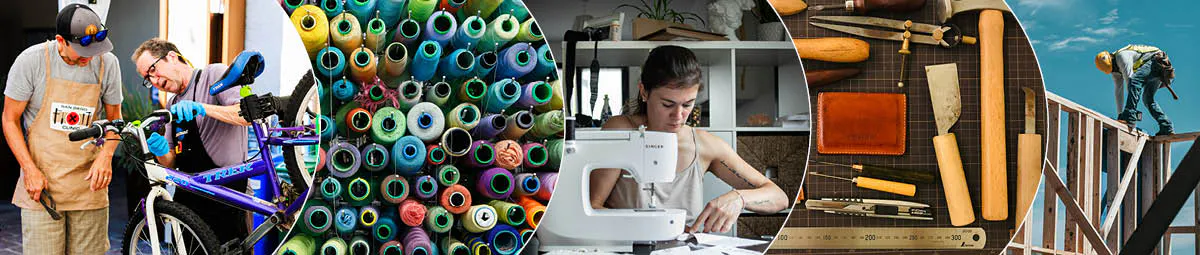
The County is working to reduce waste and build a stronger, more sustainable region. Through From Waste to Worth: A Circular Economy for Regional Prosperity, we are exploring ways to keep materials in use, support local businesses, and create new opportunities for communities across the region. This project will look for ways to support local businesses, entrepreneurs, and community leadership through the lens of:
- Sharing
- Reusing
- Repairing
- Remanufacturing
- Upcycling existing materials and products
A circular economy is a system where everything is reused and nothing is thrown away. Products and materials stay in use through practices like maintenance, reuse, recycling, and composting.
We want your ideas to help: support reuse, create local jobs, spur innovation, and build a stronger, more resilient community. Your insights will help us understand what works, what challenges exist, and where new opportunities lie. This will guide fair and practical recommendations for the region and the County.
Consultant Team: Buro Happold, MIG, Cumming Group, City Heights CDC
October 2026 Update
Following a baseline assessment that included evaluating how products move through the region from raw materials to their final lifecycle destination, next steps completed were researching policies and programs to identify gaps and opportunities by examining actions taken in other municipalities. With this, potential strategies for the region were ranked based on real‑world data and government examples, helping the County understand which actions offer the strongest potential for impact.
What We’ve Heard From You
Several common themes emerged through 12 initial interviews, four introductory public workshops, four sector-specific workshops, and 70 survey responses:
- Space and infrastructure: lack of storage, sorting, repair, warehousing, and reuse hubs — especially in East and South County.
- Workforce development: on-the job repair, textile skills, deconstruction training, and technical upskilling.
- Policy clarity: simpler permitting pathways and regional consistency in regulations, labels, and recycling rules.
- Extended Producer responsibility: clearer rules, better take-back systems, and upstream accountability.
- Community-centered education: multilingual, culturally relevant, and problem-based learning.
Coming Next – Draft Roadmap: From Waste to Worth
The Roadmap brings together the baseline assessment and stakeholder input to identify strategies for the region in five themes: (1) governance, policy, and regulation; (2) financial mechanisms and market signals; (3) circular infrastructure; (4) research and innovation; and (5) communication, education, and culture change; and for four priority sectors:
- Building materials
- Plastics
- Textiles
- Cross-cutting sector for strategies that apply across multiple sectors
The Draft Roadmap will outline recommended actions for each priority sector, each including a summary description, local examples, implementation considerations for metrics/data points, possible partners, and global case studies.
How to Get Involved
- Attend upcoming virtual session on 10/29 to learn more and offer feedback
- Share the information about this effort with others
- Provide input via public comment (anticipated for November) and ask questions using the tools on this page
Share your experiences with circular economy
I have a hobby making upcycled succulent planters from recycled glass jars/bottles and ceramic mugs. Currently my family/friends save recycled containers for me, but I would love to have access to all the recycled glass jars (or ideally discarded ones in the thrash, before they get thrown into a landfill). I wish there was a large public reuse center open to the community where we could go and select materials for free. Currently there are places like reuse art supply stores which rely on donations and then sell these materials at discount, but I would love to go to a recycling center and get bulk items for free. Not sure how cost effective this might be? But my guess is many others in the community would also use and benefit from something like this. We could get reusable materials for free, create products from them, and then sell them.
Buy Nothing has a strong community in my area (Hillcrest/University Heights). There are so many small things I was able to give away and get from this group. From mason jars, to a flyswatter, I did not have to spend money or cause more manufacturing for these things. Because everyone uses Amazon and many times Amazon does not sell a single small item, but rather likes to sell a set, folks often have extras of these small items around.
One challenge is finding unique gifts and packaging for friends and family that are low waste. I like the challenge of making things - like chocolates or lip balm, but I can't ask others to put the time in to do the same for me.


Thank you for your contribution!
Help us reach out to more people in the community
Share this with family and friends