

FAQs
- To what extent is increased investment in prevention services impacting the rate of child abuse and neglect?
- How does the County foster trust between residents and County government?
- To what extent do graduates of the Library High School Program experience changes in their future formal education, career advancement, or earnings?
- How has the two-year Childcare Blueprint changed the County childcare system?
- What County data is most relevant to the community, and to what extent is it available, accessible, and usable?
- How can the County make it easier and less time consuming for residents to learn about and access services?
- How can internally-facing County departments make processes more efficient so other departments can better utilize their services?
- How can the County most effectively prevent and reduce homelessness?
- What strategies are most effective in reducing social isolation and promoting mental well-being for subgroups experiencing the highest levels of social isolation?
- To what extent do existing equity planning documents and tools enable departments to use an equity lens and utilize the lived experience of the community to design, implement, and improve programs and services?
- How can the County's procurement process foster equitable economic development?
- What outreach methods are most effective for increasing awareness of and participation in Medi-Cal by older adults age 60+?
- How can the County use alternatives to incarceration approaches to reduce the number of people involved in the justice system?
- How do the collaborative efforts of law enforcement, social services, public health, and community organizations reduce gun violence in San Diego County?
- What effect do behavioral health crisis interventions have on law enforcement resources and client outcomes?
- What climate action measures will produce the most return on investment for greenhouse gas reductions, improved air quality, green jobs, and increased equity?
- To what extent do alternative strategies for green infrastructure project procurement and implementation impact the speed, quality, and co-benefits delivered (e.g., social, economic, and environmental) in comparison to traditional methods?
- How can the County most effectively meet regional, state, and federal goals in the Regional Decarbonization Framework?
What questions are currently in the ASRP?
There are 18 questions in the 2025 ASRP. You can find more information about the questions on the ASRP website.
How did you use community input in 2025?
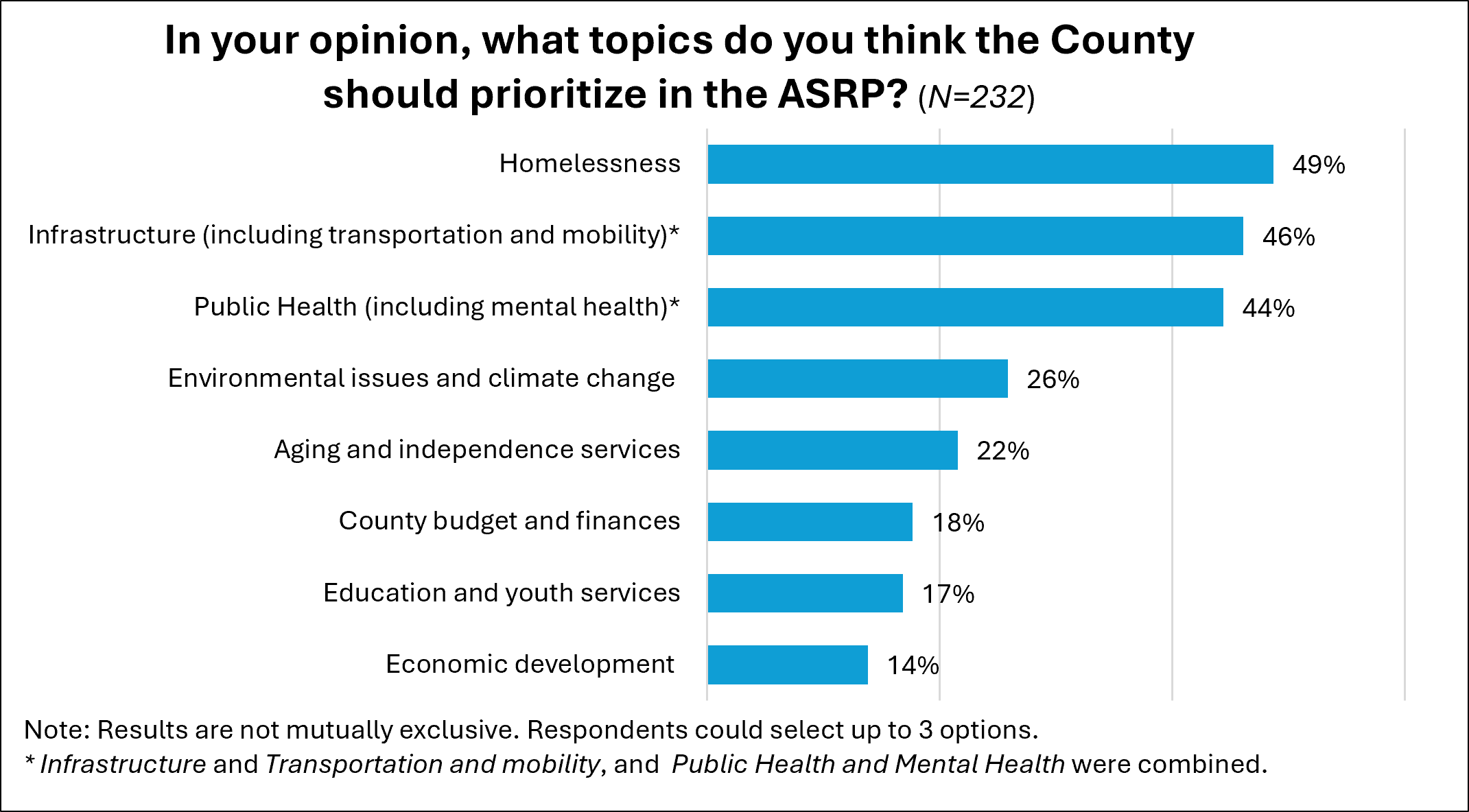
Last year, we surveyed residents to find out what topics were most important to you and used these responses when prioritizing which questions to include in the ASRP. The survey showed that the highest priority policy areas were Homelessness (49%), Infrastructure (46%), and Public Health, including Mental Health (44%).
When asked how the County should decide what to research, the top reasons people surveyed gave were: to better understand the community’s needs (65%), to improve programs and services (57%), to support data-driven decision making (46%), and to create accountability (42%).
When asked how the County should decide what to research, the top reasons people surveyed gave were: to better understand the community’s needs (65%), to improve programs and services (57%), to support data-driven decision making (46%), and to create accountability (42%)
.
What have you learned from research so far?
We have research projects to answer many of the questions in the ASRP. Here’s some of what we’ve learned so far:
How can the County use alternatives to incarceration approaches to reduce the number of people involved in the justice system?
San Diego County launched a new interactive report that shows how the County’s Alternatives to Incarceration (ATI) programs make a difference in what people experience before and after time in local jails. The web report features initial data from the County’s Alternatives to Incarceration initiative, launched in 2023. Under the initiative, County departments and community partners work together to make sure people who commit low-level crimes get the kind of help they need to keep them away from jail in the first place, or from ever returning to it. Otherwise, for many, jail can turn into an endless cycle of new crime, poor behavioral health, potential homelessness and poverty.
How can the County most effectively prevent and reduce homelessness?
Recently, the County’s Office of Evaluation, Performance, and Analytics published an impact evaluation report in collaboration with Georgetown University’s Better Government Lab. The study found that a one-time $4,000 payment may have provided short-term relief to buy food, pay for utilities, or pay-off debt. But it found no measurable improvements in well-being or reductions in public benefit use six months after receiving the payments. Given these findings, the evaluators recommended that the County not repeat the program in its current form.